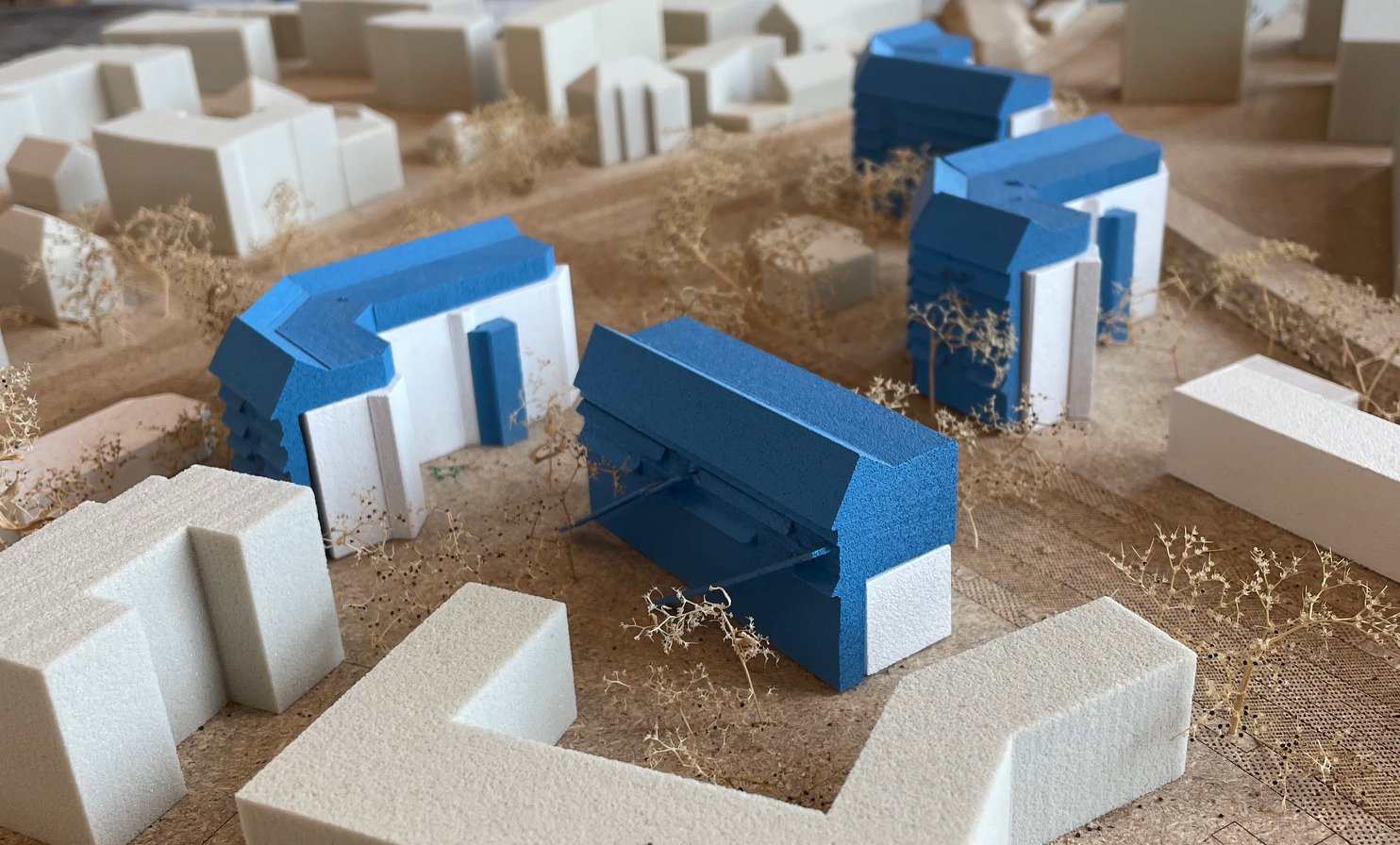
Student Model (J. Stainhauser, M. Weber) Design for Climate course (2023)
Project Page /
SynEnergy - Densification of existing buildings
Duration /
2024 - 2027
Funding /
Innosuisse: Swiss Innovation Agency
A/S Team /
M. Gester, I. Hischier, A. Schlueter
Key Partners /
Td Lab (ETH Zurich)
Chair of Spatial Development and Urban Policy, SPUR (ETH Zurich)
Chair of Structural Design at D-ARCH (ETH Zurich)
Amt für Hochbauten, Stadt Zürich
Amt für Städtebau, Stadt Zürich
Stiftung PWG
Allgemeine Baugenossenschaft Zürich (ABZ)
Stiftung Alterswohnungen der Stadt Zürich (SAW)
Familienheimgenossenschaft Zürich (FGZ)
Publication /
D. Büttiker, A. Galimshina and I. Hischier, 'Renovation, replacement, or vertical extension? Assessing densification strategies to reduce the environmental impact', Energy and Buildings, vol. 357, p. 117165, 2026, doi: 10.1016/j.enbuild.2026.117165.
M. Gester, I. Hischier and A. Schlueter, 'Sustainable Vertical Extension in Zurich - Mapping the Diversity of Perspectives with a Constellation Analysis', IOP Conference Series: Earth and Environmental Science, vol. 1554, no. 1, p. 012138, 2025, doi: 10.1088/1755-1315/1554/1/012138.
The project investigates vertical extensions, or Aufstockungen, as a specific form of soft densification in Zurich's existing residential building stock. Vertical extensions can create additional housing while preserving existing buildings and combining densification with retrofit strategies. Their feasibility, however, depends on the interaction of structural reserves, energy performance, greenhouse gas emissions, housing quality, outdoor space, social compatibility, costs, and regulatory conditions.
The project, therefore, approaches vertical extensions as a socio-technical challenge. Rather than assessing densification only through technical performance indicators, the research examines the interaction between architectural, structural, environmental, regulatory, economic, and social factors. This allows for a better understanding of where vertical extensions can offer robust sustainability benefits, where they face critical barriers, and under which framework conditions they may become a viable alternative to replacement construction.
Following a transdisciplinary process of knowledge co-production, the project works closely with the City of Zurich and four non-profit housing organizations: Stiftung PWG, ABZ, SAW, and FGZ. Through workshops, case study analyses, and stakeholder discussions, the research bridges scientific assessment and practical implementation. The aim is to develop shared evaluation criteria and decision-support tools that make the opportunities and trade-offs of vertical extensions visible at an early planning stage.