SNSF NRP81 Beyond Replacement Construction
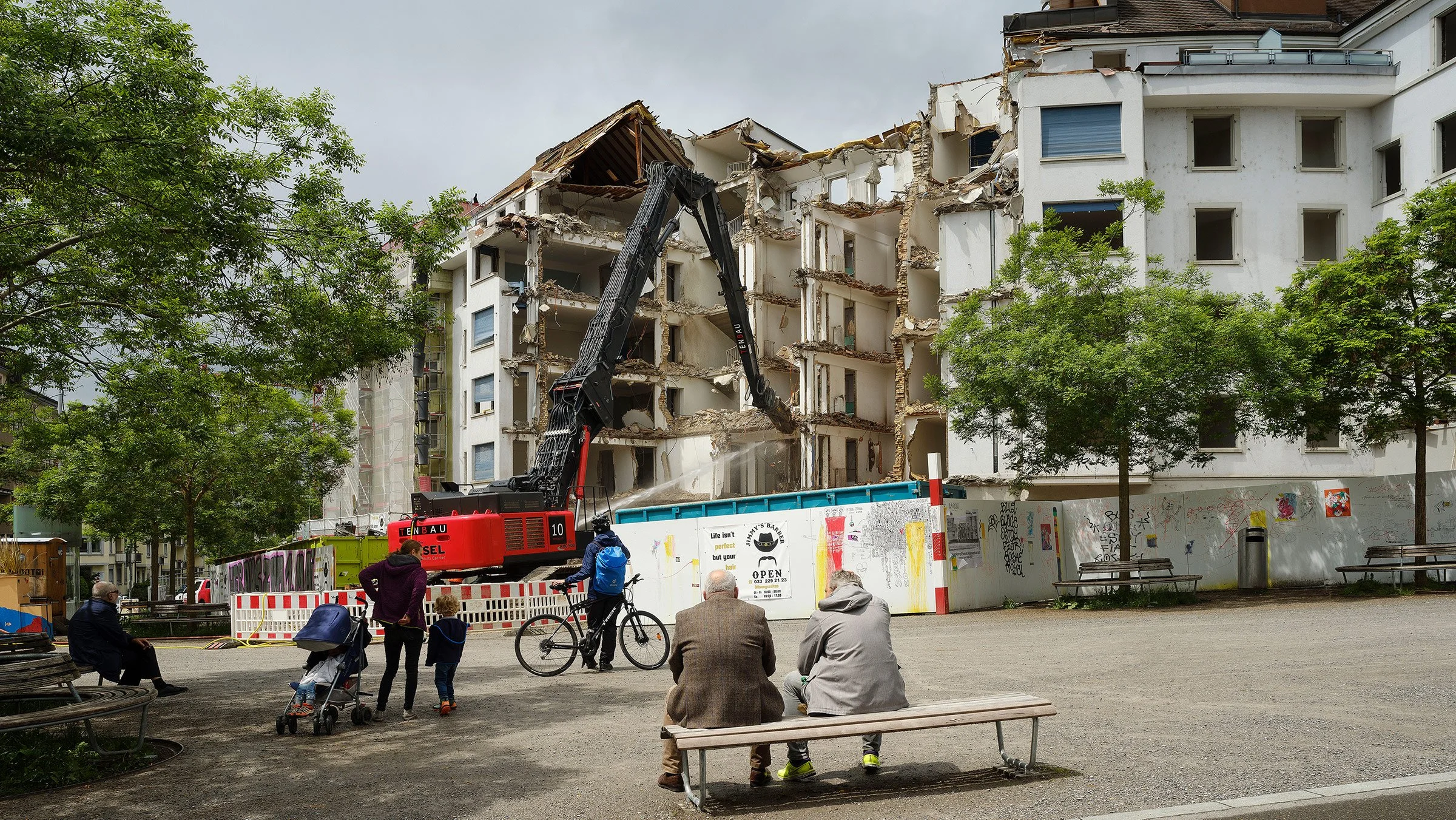
A demolition at Roeschibachplatz in the city of Zurich. (Photo by: Keystone-SDA)
Project Page /
Sanfte Verdichtung statt Ersatzneubau
Duration /
2025 - 2029
Funding /
Swiss National Science Foundation
A/S Team /
B. Bernadino, A. Schlueter
Key Partners /
Chair of Spatial Development and Urban Policy, SPUR (ETH Zurich)
Chair of Structural Design at DARCH (ETH Zurich)
Publication /
B. Bernadino and Z. Shi, ‘Should we construct more skyscrapers? Scenario-based, energy performance assessment of plausible future urban densifications’, J. Phys.: Conf. Ser., vol. 3140, no. 6, p. 062017, Nov. 2025, doi: 10.1088/1742-6596/3140/6/062017.
B. Bernadino, ‘From Efficiency to Sufficiency: Are We Densifying Cities the Wrong Way?’, Energy Blog @ ETH Zurich. Accessed: Feb. 13, 2026. [Online]. Available: https://energyblog.ethz.ch/densifying-cities/
In our research group, we are addressing the challenges posed by the implementation of urban residential densification in Switzerland. The current trend of "hard" densification through total demolition and reconstruction results in significant CO2 emissions and displaces lower-income residents. Our work advocates for soft densification as a more socio-ecological alternative to the prevailing approach for densification. Soft densification comes in multiple typologies, such as vertical extensions, infill development, and use conversion. The project aims to understand the potential of soft densification, the complex negotiation between stakeholders, and implementation processes in Swiss settings.
A core pillar of our Chair’s contribution is the development of a multi-scale, multi-determinant framework to systematically map this potential. Our proposed methodology enhances Urban Building Energy Modelling (UBEM) from a techno-architectural simulation into a socio-technical framework by embedding socio-economic data and local planning determinants directly into our models. We test this methodology in four municipalities: Winterthur, Kloten, Lausanne, and Renens. This approach allows us to move beyond isolated building assessments toward scalable, neighbourhood-level solutions that account for both energy performance and other non-technical considerations. We hypothesise that systematically identifying this potential will enable the strategic implementation of soft densification. Ultimately, our goal is to catalyse a paradigm shift in Swiss building culture, providing the data-driven assessment necessary for a more socio-ecologically grounded urban transformation.